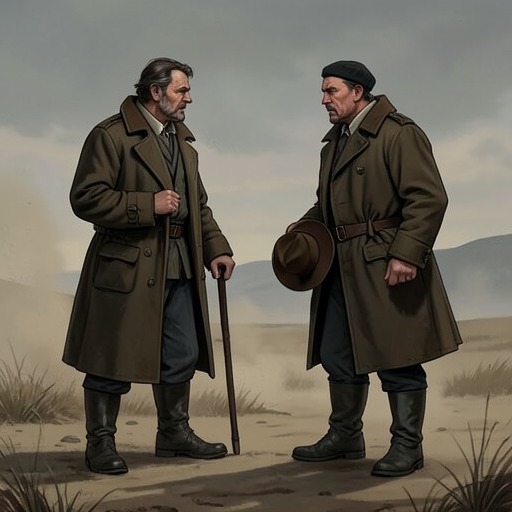
Boldwood's attempt to buy Troy's departure
Far from the Madding CrowdBoldwood's attempt to buy Troy's departure is a failed effort to manage love and rivalry as a business transaction. Hoping to protect Bathsheba and redirect Troy toward Fanny Robin, Boldwood offers money in exchange for Troy's immediate departure and a marriage to Fanny. Troy takes the payment, but his concealed marriage to Bathsheba makes the bargain impossible from the outset. The encounter ends with Boldwood's offer rejected and thrown into the road, leaving him humiliated and more deeply entangled in his fixation on Bathsheba.
Causes and Background
Boldwood approaches Troy after seeing him arrive in Weatherbury late at night with a bag that seems ready for another departure. He has heard Troy's attachment to Fanny Robin is known to very few people in the village, and believes Troy ought to marry her. At the same time, Boldwood considers himself nearly engaged to Bathsheba, though Troy corrects him: they were not engaged. Boldwood insists that, had Troy not appeared, Bathsheba would by then have accepted him. His offer therefore grows from two linked desires: to remove a rival from Bathsheba's life and to turn Troy toward the woman Boldwood believes he has wronged.
The proposal also reveals how far Boldwood has moved from his former self-command. He tells Troy that he will avoid debating right and wrong, a woman's honour, or Troy's conduct, and instead frames the matter as a business transaction. The narrative contrasts this calculating language with the emotional motive beneath it: Boldwood has become so invested in Bathsheba that he tries to purchase an outcome he cannot otherwise secure. His assessment of Troy's prospects is mistaken, and he knows little about Fanny's situation or whereabouts. The apparent practicality of the plan thus rests on limited knowledge and a personal desperation that narrows his judgment.
The Offer and Troy's Acceptance
Boldwood urges Troy to abandon the hope of marrying Bathsheba, whom he describes as too far above Troy in station, and to accept a more attainable marriage with Fanny. He offers fifty pounds immediately if Troy will leave Weatherbury that night, another fifty pounds for Fanny's preparations once Troy identifies where she is living, and five hundred pounds on the wedding day. The scale and timing of the payments make the offer concrete: Boldwood is prepared to part with money at once in exchange for a future arrangement he hopes to control.
Troy tells Boldwood that he likes Fanny best and agrees to the arrangement, but he also admits that Bathsheba had inflamed him and displaced Fanny for a time. His apparent willingness to comply is compromised by his interest in the cash and by what he is withholding. Boldwood hands him fifty sovereigns. When Troy questions why Boldwood has brought the money ready, Boldwood says he had anticipated that Troy might accept; he adds that Troy can be trusted not to forfeit the prospect of the larger sum or make an enemy of a potentially useful friend. Rather than relying on honour, he tries to secure obedience through calculation and financial incentive.
The Reversal at Bathsheba's Door
The bargain changes when Bathsheba approaches on the road. Troy tells Boldwood that she expects him that night, and explains that she has sent the household away so that his visit will be private. He says he will meet her, then tells Boldwood that she will think more about him if he disappears without explanation. Boldwood initially wants to hear the conversation and insists that Troy limit himself to saying he has come to give her up. The arrangement puts Boldwood in the position of waiting nearby while the man he is paying speaks to Bathsheba.
When Troy and Bathsheba meet, her words make clear that she expects him and has arranged for the house to be empty. Troy sends her home ahead of him, promising to follow shortly. Boldwood understands that the meeting is not simply a farewell. Troy then states the contradiction at the heart of his own conduct: he cannot marry both women, and chooses Fanny because he likes her best overall and because Boldwood is paying him. Boldwood tries to stop him, first threatening him, then reversing course and urging him to marry Bathsheba instead. He even offers to redirect the five hundred pounds to Bathsheba, hoping money can still secure the marriage he wants for her.
The Secret Marriage Revealed
At Bathsheba's entrance, Troy goes inside and leaves Boldwood waiting outside. He soon appears behind the chained door with a candle and a folded newspaper. The printed marriage notice records that Francis Troy and Bathsheba, the daughter of John Everdene of Casterbridge, were married at St. Ambrose's Church in Bath on the seventeenth of that month. Boldwood learns that Bathsheba is already Troy's wife; the supposed opportunity to win her through Troy's departure has vanished before the negotiation began.
Troy reduces the failed bargain to its absurd arithmetic: fifty pounds to marry Fanny, then twenty-one additional pounds not to marry Fanny but Bathsheba, while he is already Bathsheba's husband. He tells Boldwood that Fanny left him long ago and that he does not know where she is, further exposing how little basis the proposed arrangement had. He also reproaches Boldwood for believing Bathsheba dishonourable on what he calls the slightest apparent evidence. The rebuke is pointedly self-serving, but it identifies the weakness in Boldwood's understanding: his offer assumes that he can judge and manage the private relationships involved without knowing their actual circumstances.
Consequences and Significance
Boldwood refuses to take the money back, but Troy wraps the packet in the notes and throws it into the road. Boldwood answers with a threat of punishment; Troy closes and locks the door. The attempted purchase has secured neither Troy's departure nor Fanny's marriage, and it has disclosed to Boldwood the fact that Bathsheba's marriage has already taken place. The exchange turns his hope into public-feeling humiliation, while Troy leaves the scene with the advantage of knowing that the secret marriage makes Boldwood's whole scheme obsolete.
The scene's central reversal is the collision between Boldwood's confidence in money as leverage and the fact he does not know: Bathsheba and Troy are already married. Its irony is sharpened by Boldwood's unstable purpose. He begins by trying to buy Troy's departure from Bathsheba, then, when he learns Bathsheba loves Troy, urges Troy to marry her and offers to pay for that outcome instead. In the same encounter, Boldwood's possessive hopes, Troy's opportunism, and the consequences of Bathsheba's secret marriage converge. The failed negotiation does not settle the rivalry; it leaves Boldwood with a newly confirmed marital barrier and a grievance that continues to govern his actions.